We continue this week our journeys through the Easter season. Yes, we celebrate Easter on Resurrection Sunday, and Easter’s alleluias ring out across seven weeks of the liturgical year. Sometimes called Eastertide, or the Great Fifty Days, the season began at sundown the evening before Easter Sunday and continues until Pentecost Sunday on May 23, 2021.
What this means is that Commencement 2021 will occur in the midst of Eastertide, on the Monday between Ascension Day and Pentecost Sunday. Between now and then, students and faculty will write many more words and create and grade a number of final projects. The Great Fifty Days will be, for the School of Divinity, a time for ending another academic year. It will also be a time for us to reflect on what we have learned across the pandemic weeks and months. How have we been changed? What has been resurrected in us? In our communities? What radical alleluias do we yearn to lift up as we consider the aching wounds and needs in our world? What joyful alleluias bring sweet relief to our pandemic-parched lips?
I wish you blessed journeys, Wake Div, as we move through the Great Fifty Days. Perhaps Eastertide’s “alleluia” song can infuse the last days of this semester with new energy and a renewed sense of vocational purpose.
God will fill your mouth with laughter and your lips with shouts of joy.
Job 8:21
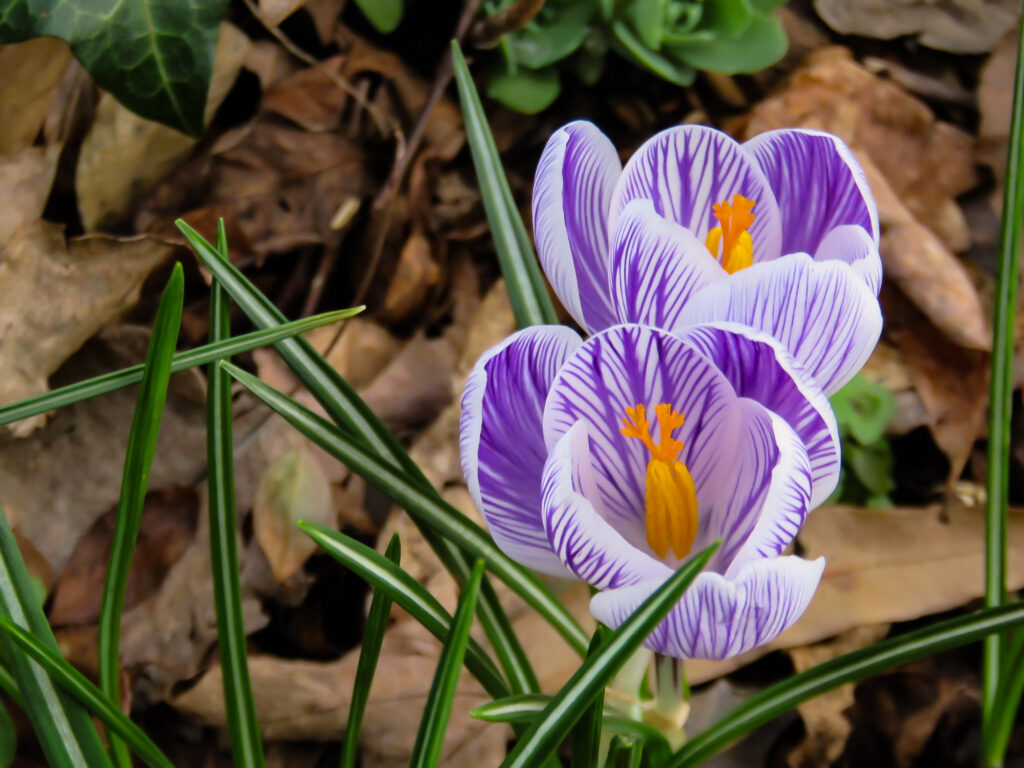
Risen! (photo by Jill Crainshaw)
risus paschalis: when dust laughs
spring has ambushed winter, and the dust of the earth is, yet again, transfigured into wind-dancing laughter.
laughing dust? not here in this graveyard of abandoned joys where dead-ended dreams whisper like violated ghosts among tombs of those too-soon returned to the earth.
you just smile and sink your spade into the sun-warmed sod, costly corruptions composted, turned, turned again until soil recognizes soil.
then you wink, just once, and the remembered dust, tantalized by the tickle of a new feast’s first thin blade, laughs.
I am intrigued by the varied liturgical traditions and customs that converge during Easter week each year.
Some Christian traditions call the week that begins with Easter Sunday “Bright Week.” During “Bright Week,” faith communities around the world celebrate the new light that dawned with Jesus’ resurrection. In this “Bright Week” tradition, each day of the week following Easter Sunday carries the adjective “bright.”
Easter Monday holds the additional distinction of being referred to by some as Risus Paschalis—Easter Laugh. Early orthodox communities began a tradition of gathering on the Monday following Resurrection Sunday to tell jokes as a way of marking Easter as the ultimate joke God played on Satan by defeating death with life. Some churches observe the Easter Laugh by including jokes or humorous anecdotes in their Easter Sunday sermons. Others emphasize laughter on the second Sunday of Easter, sometimes called Holy Humor or Hilarity Sunday.
Bright Week observances remind me. Life has defeated and will continue to defeat death. The promise is cosmic and infuses even the most mundane dimensions of human life. This is the power of the Easter message. Not a romanticized message. Not a triumphalistic one either. No, the power of the Easter message is its persistent hope and joy even amid uncertainty. And we have the opportunity to proclaim with our hands, feet, and hearts–with our dust-made humanity–life and hope for all people in the name of the one who made dust laugh again on Easter morning.
This Resurrection message of hope seems especially important for those in pursuit of a Master of Divinity degree. How often have people said to ministry students when they announce their decisions to undertake a divinity degree something like “are you sure you’ve thought this through?” or “are you joking?” When uncertainties arise as any of us pursue God’s call, or when everyday trials make us want to give up, or when the going gets tough and we are tempted to think the joke is on us, we can remember again the contagious, life-giving gift of the Easter laugh. Perhaps on this week’s Bright Monday we can join Sarah who all those years ago announced: “God has made me laugh. Everyone who hears will laugh with me” (Genesis 21:6).
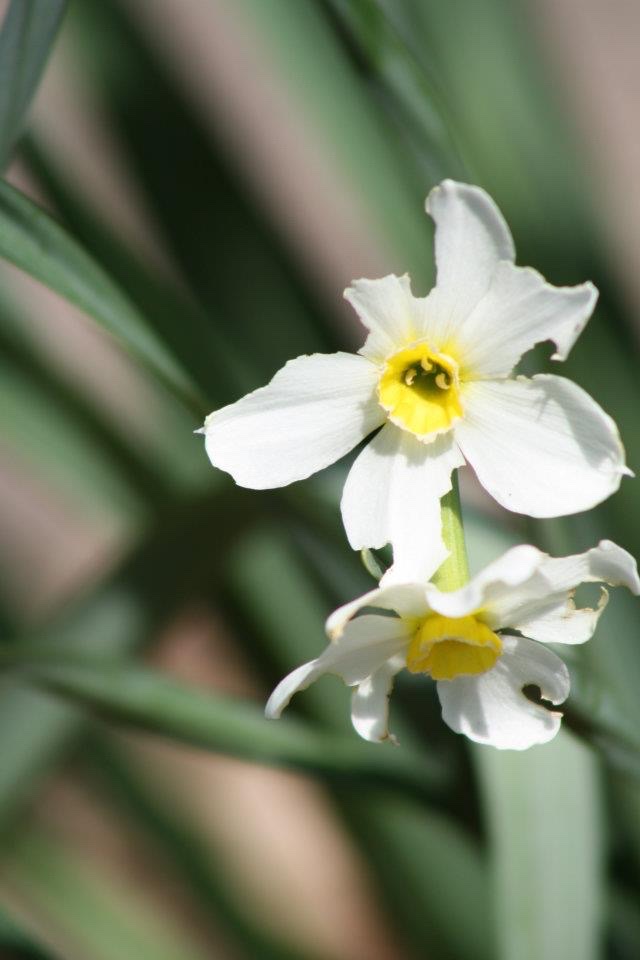
“Daffodil with Scars,” by Sheila G. Hunter, used by permission
“Rejoice with joy, you that have been in sorrow.” Isaiah 66: 10-11
Sunday, March 14, is the four Sunday of Lent. In some traditions, the fourth Sunday of Lent is called “Laetare Sunday.” Laetare means “rejoice.” To some, this may sound peculiar. Why is there a “Rejoicing Sunday” in the midst of Lenten introspection, fasting, and austerity?
The exact midpoint of Lent is the Thursday of the third week of Lent; thus, the fourth Sunday of Lent was viewed historically and still is in some traditions observed as a day of celebration. Linked to an ancient mid-March Roman festivals called the hilaria (related, of course, to the word “hilarious”), Christians viewed Laetare Sunday as a day when the somber disciplines of Lent were lessened. Laetare is also known in some places as Refreshment Sunday or Holy Humor Day or Laughter Sunday and liturgies include moments for recalling the joy of the Lord in the midst of Lenten penitential pilgrimages.
So it is that the School of Divinity in mid-March and at the midpoint of this year’s Lenten season pauses for some respite days, a time of refreshment in the midst of the semester’s regular rhythms of work, study, and learning.
As we look toward Easter and the second half of the spring term, may we be encouraged by the justice-making, liberation-giving, love-birthing light of God.
“Daffodil Prayers for Lenten Journeys”
“Dip your aching toes in cool waters,” said Summer to the wilderness wandering woman.
“Tease your tastebuds with blackberries. Lay your weary body down on gentle meadow grass. Breathe in the soft sweetness of coral honeysuckle where hummingbirds drink and dance.”
“Blush with pride,” said Autumn to the old maple tree.
“You earned it. You shaded the little girl who held summer stars in her eyes while she sat beneath your branches and read and read and read once upon a times into dreams into fierce hopes for the future.”
“Bend toward hope when icy winds blow,” said Winter to the fragile-seeming ones.
“Bend, but don’t break. You are stronger than you know. You are resilient. You are enough.”
“To push your shoulders up, up, up,” said Spring.
“Up through still-cold greening sod to fragrance the dawn with daffodil prayers.
Some thoughts on renewing our lives as we journey through lent
Isaiah 35:1-2 is one of my favorite Lenten texts:
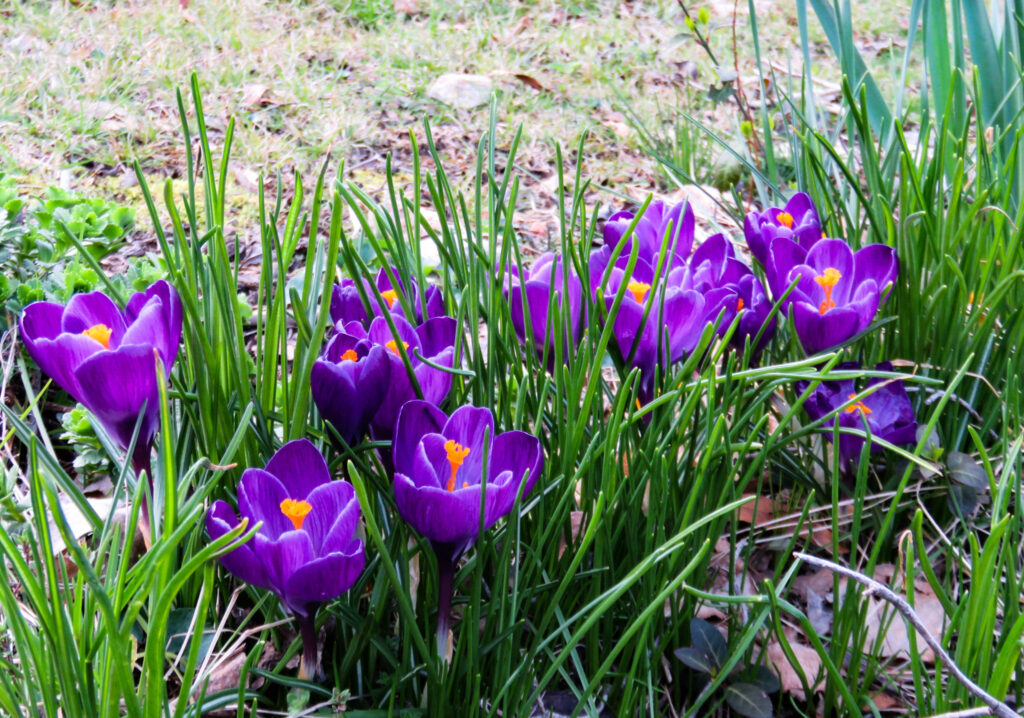
“The wilderness and the dry land shall be glad; the desert shall rejoice and blossom; like the crocus, it shall blossom abundantly, and rejoice with joy and singing.”
As we consider crocus blooms in Lent’s desert places, perhaps we can also imagine new or unexpected ways to continue to thrive in this season of wilderness wa(o)ndering.
Have you ever felt like you want to reboot and reimagine your professional or personal life?
We all experience those spans of time when we realize we need to get unstuck or disentangled from something in order to thrive in our personal and professional lives.
In my work with mid-career professionals, I have learned some strategies for thriving that are valuable for people at any stage of life. Here are five keys to thriving:
T ruth-telling
H umor
R espect
I magination
V oice
E ngagement
Vital to thriving is to become honest about who we are and what we want for our lives. We need to become truth-tellers, in particular about our own desires and needs. While this is serious work, doing it with a sense of humor helps lighten the load. Generous, authentic, and hospitable laughter is a gift. And some of our efforts to get untangled from sticky webs? Humorous.
Respect for self and others is also a gift. And it is essential to thriving.
Respect for self means paying attention to our needs. Respect means listening to our hearts. Respect means affirming our value.
Respect for others is also essential. We do not travel professional roads alone. Hospitality toward co-travelers builds healthy networks of relationship and support.
What do we envision for our lives and relationships when we let loose our imaginations? What possibilities do we see for our workplaces? Imagination and transformation are dance partners in this thriving work.
Again, we have to listen to ourselves if we want to thrive. What is my voice telling me about my life? What wisdom is my voice speaking about my wounds? About the journey ahead?
The beauty and power of listening for my voice? When I pay attention to my most authentic voice, I become more open to hearing the voices of others. We thrive when we engage the people around us in healthy ways. And we contribute to the thriving of others.
I invite you to consider some concrete strategies you have embodied to thrive in your professional and personal lives. You can learn more about these five keys in my fall 2020 publication Thrive: How professionals 55 and over can get unstuck and renew their lives. I am also glad to brainstorm with you and hear your wisdom about thriving. Reach out to me at crainsjy@wfu.edu.
Sometimes I can’t see what is right in front of me.
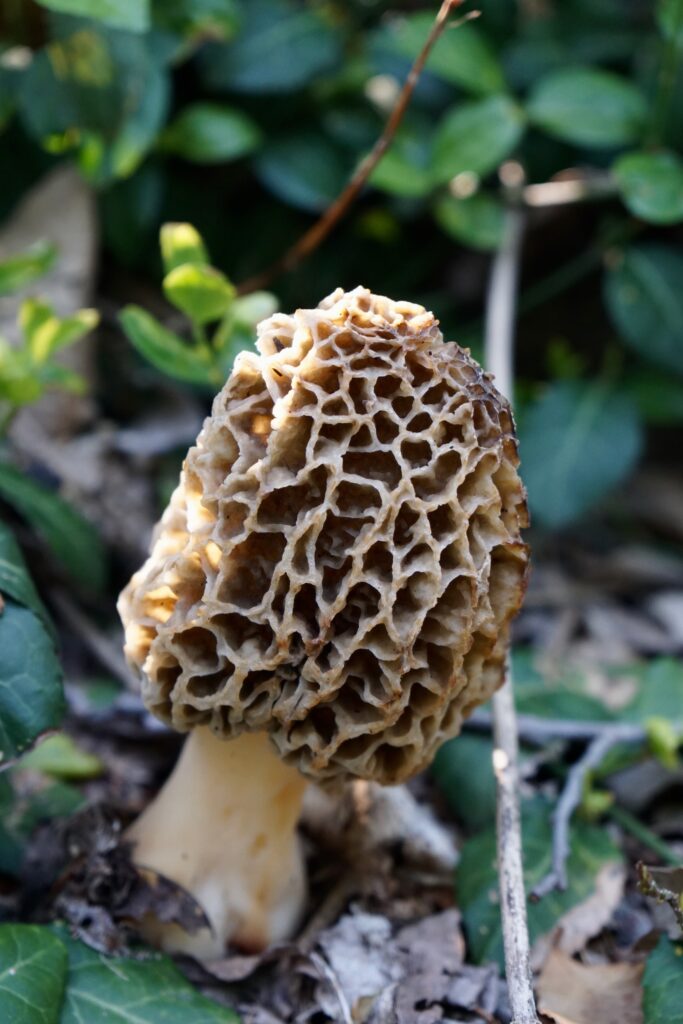
Some friends in Virginia had what I call “mushroom vision.” They loved to hunt for morel mushrooms that grow wild in the woods, and they knew how to spot them among the springtime leaves and undergrowth. This, in my experience, is no easy task. Morels are masterful camouflagers. Often when I ventured out on a mushroom hunt with friends? My shoe was squashing the forest delicacy before I even knew I had “found” it.
Sometimes I can’t see what is right in front of me, and sometimes that is because I don’t know what I’m looking for.
But other times? I think I miss seeing some of life’s gifts because my eyes are focused elsewhere. Or my mind is. Or my heart. Sometimes my perspective is off kilter, or my eyes are just too world-weary to see beyond the stack of work in front of me.
Quarantine and social-distancing days have nudged me to see with a new intensity much beauty around me I have overlooked or taken for granted before. This is an unexpected gift of the pandemic. Birds seem more abundant and full-throated than usual. Last spring, even as the pandemic took hold, my irises were bolder and more loquacious than ever. And I am in awe of the cedar waxwings that feasted on a holly berry buffet in our neighborhood a few weeks ago.
Catching sight of creation’s gifts like these in the midst of wilderness times gives me hope.
What is that hope? My hope is that during uncertain times we—the collective communal we—gain new perspectives on our communities’ amazing gifts. In fact, once we know what we are looking for, perhaps we can see, experience, and celebrate new connections with colleagues, co-workers and community members. Perhaps we can forge unexpected relationships that lead to imaginative ideas for contributing to the flourishing of our communities.
I relish my connections with faculty, staff, and students within the Wake Div community, even if most of those connections these days are through Zoom’s peculiar windows in walls. And I challenge myself this week to make one new connection with someone at Wake Div. Perhaps you will join me and seek out a new connection or partnership in the days ahead.
Fried morel mushrooms, by the way, are a tasty delicacy, if you can find them. Of course, you have to know something about what you are looking for; not all mushrooms result in gastric delights!
Ode to the River Down the Road *written on the occasion of noticing the river in my neighborhood as if for the first time. It’s been too long, old friend, since I last saw you dance— not because you weren’t moving but because my ears were too full of distracting debris to listen for your music.
Ancient rocks welcome your embrace. Pebbles laugh in sun-touched delight as you slip and slide across their backs. And trees lean in close to hear you whisper the secrets rivers keep.
Thank you for continuing to twist tumble turn to the music of the spheres.
As a teacher this semester, I am excited about reading the written work of my students. I know from past experience how many wonderful insights, questions, and big ideas surface from mysterious depths as students craft reflections and essays. I celebrate the gifts that await our shared discovery, springtime gifts just beneath the surface, soon to shoulder their way up through winter soil.
Even as I anticipate the gifts of student writing, I know that the semester will bring some long, perhaps even painful, nights when inspiration eludes both teachers and students, when our muse is more enemy than friend. For those moments when we are word-and-world-weary, I share this image from writer and poet, Pat Schneider:
Tonight, words are turtles sleeping under mud. Even when I poke them they will not wake up. Leave us alone, their silence says. When we decide to surface, we will tell you what we dreamed.
Writing is an intentional and inner act, Schneider says. She also says that “writing and prayer are both a form of love, and love takes courage.”
As we all poke countless sleeping turtles this semester, I hope that we find courage to write with wisdom and honesty (to the best of our ability). I also hope that as we sometimes brood over the empty screen in front of us we meet Spirit-mystery and encounter unexpected truths.
Words of wisdom from Alice Walker:
When we let Spirit Lead us It is impossible To know Where We are being led. All we know All we can believe All we can hope Is that We are going Home That wherever Spirit Takes us Is where We Live.
During these “epiphanous” weeks—during January—nature’s light daily grows stronger. Days are longer, nights shorter. Though January is still with us and the possibility of winter snow colors skies and clouds, we glimpse here and there promises of another springtime’s new life.
Some Christian communities observe in addition to the feast day of Epiphany an Epiphany season after Christmas. The season lasts for varying periods of time, depending on the tradition. Most common is a forty day Epiphany season that ends with Candlemas, or the Presentation of Christ in the Temple, in early February.
Three Epiphany stories grace the Christian tradition: the visit of the sages, the baptism of Jesus, and the wedding feast at Cana. Through each, we celebrate emerging light—the light of a winter-becoming spring-sun and the always new light of God’s grace.
As we begin another semester here at Wake Forest University School of Divinity, enrolling in new courses and cherishing as yet unopened books that beckon us to explore fresh theological and ministry wisdom, perhaps we can recall and even embody Epiphany’s promises of unexpected insights and expanding light.
Welcome back, Wake Div! May we discover expanding light in the semester ahead. And may we find courage to be light–to embody God’s light of mercy, love, and grace–in the places where we live, work, study, and serve.
Some thoughts as we head into the Season of Advent
Light-catcher
. . . and the stars will be falling from heaven.
Mark 13:25
Apocalyptic stars make a grand appearance in the lectionary texts for the First Sunday of Advent. I was reminded of these Advent stars when I walked in my neighborhood a few nights ago. A crescent moon wandered up beneath two twinkling luminaries, and I thought about our longings for light in our nighttime places.
2020 has been a year of uncertainties. Many stars we thought forever anchored in place seem to be falling or wavering.
In the midst of these uncertainties, I have been grateful for connecting with students, even if only by Zoom, for amazing wisdom and insights shared by colleagues, for accomplishments celebrated, for chapel services shared together. Many glittering granules of community and learning together have filled me with Spirit-hope.
Thank you, students and colleagues, for inviting me to catch bits and pieces of light across this semester. I cherish the fire that together they and we have created in my heart and mind.
I wish you blessings on the remaining weeks of the semester and as we begin another Advent season.
“The stars are falling–“ was she asking or announcing? “a sign of the times.”
A moon sickle slid beneath the stars– to catch them, perhaps, as they tumble through turbulent times to a light-hungry earth?
“She will hold the pieces,” I said and smiled at the hopeful moon– bent on cradling the aching light until she is full– one more time.
**Thanks to all who helped to make possible a smooth registration period. Please reach out to the Office of Academic Affairs if you have questions or concerns about your Spring 2021 schedule.
Over many years, theologians, educators, ministers, and communities of faith have wrestled with and debated this question. Responses have been as varied as the persons who give voice to them.
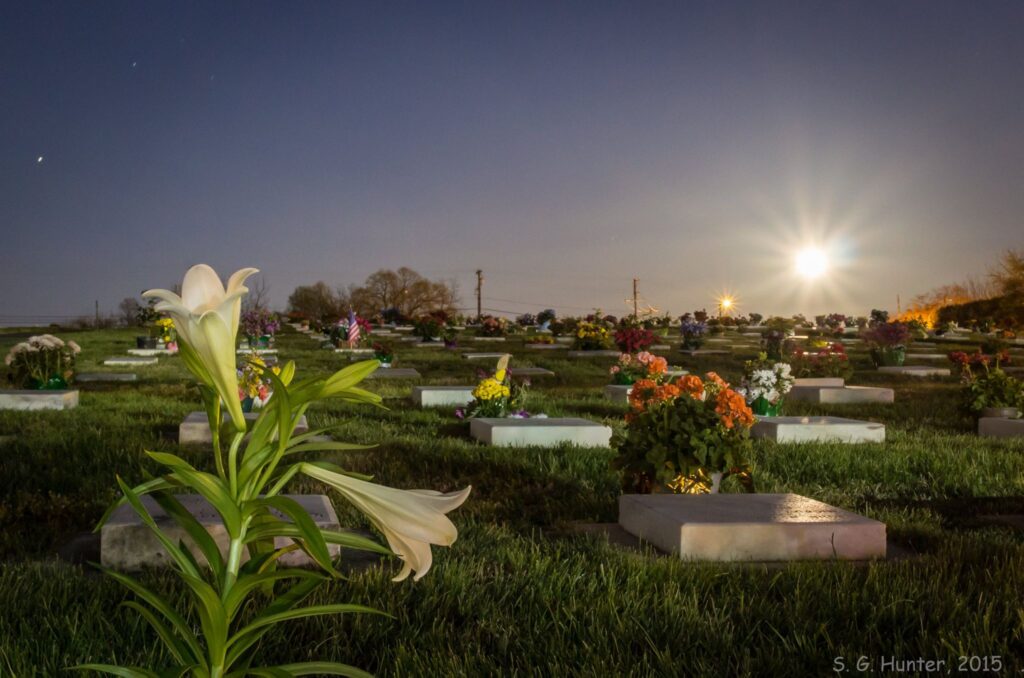
As we move closer to the end of this fall term, I offer in this post a visual response to the question. Sheila Hunter, a local piano technician and artist, shot the photograph you see here several Novembers ago as a waning moon began to rise up over God’s Acre in Old Salem. The photo was taken during autumn’s 7pm darkness. Sheila did not use a flash. The light in the photo is the light gathered from a time exposed shot taken with a camera on a tripod.
Why so much light in a nighttime image? Photographer Sheila reports that the lens of the camera opened wide and then for as long as five seconds, an eternity in the photography world, absorbed information from the surroundings until it had adequate light for this particular shot. A good analogy is what happens to human vision when we walk into a darkened room. Our eyes take a moment to adjust to the light. Then, gradually, we can see the shapes of chairs or sofas, thus avoiding stumping a toe.
If this photo were a response to the question “What is theological education?” it might suggest that theological education opens ours hearts and minds to take in a more than usual amount of data about “things theological,” for example, God, faith, culture, cosmology, and humanity. Theological education, we hope, increases our capacity to encounter light in the midst of shadowy and uncertain places. At least, we might think of theological education in this way as we approach the end of a semester during which many people have sought light and hope.
Notes for this week:
Registration begins this week. If you need assistance during the registration period, contact the Office of Academic Affairs at acadiv@wfu.edu.
The last day for all in person classes is November 20. We will have fully remote instruction until classes end on December. Fall exams are December 7-12.
These words from Psalm 27 are the “opening sentences” for each day’s office of morning prayer in Celtic Daily Prayer. They offer wise counsel as we journey into the last third of the fall term.
So much has happened this semester. Some assignments have been completed and others are under way. Art of Ministry internships have brought gifts and challenges. Students in clinical pastoral education are visiting patients, presenting event accounts, and exploring theological and vocational identities with their supervisors. Faculty members are busy with teaching and writing, committee meetings, and community leadership. Staff persons are planning events and providing vital leadership and support.
And we have found ourselves this doing all of this during a pandemic, as a contentious election season draws to an end, and in the midst of ongoing individual and communal life challenges and difficulties.
So, a new week begins. We have a new President-elect and Vice President-elect. Students are meeting with advisers to plan for the spring semester. We have hope—and worries—about many life realities. I wonder. In the midst of the chaotic swirl of daily schedules and the stresses of academic deadlines and other life responsibilities, can we lean in and hear the Psalm 27 poet asking: What is the most important thing that you are asking of and seeking from God as you undertake this work of theological education? What is the source of your calling to ministry or to this educational journey?
My fellow Wake Div-ers, please hear my gratitude for each of you. Your presence in our community and your ministry callings—the passions and dreams that led you to theological education and Wake Div–they matter, and they make a palpable and prophetic difference in the places where you live and work, laugh and lament.
Another daily office, this one from the New Zealand Book of Common Prayer, includes in its Night Prayer these words:
It is night after a long day.
What has been done has been done;
What has not been done has not been done.
Let it be.
The night heralds the dawn.
Let us look expectantly to a new day,
new joys, new possibilities.
In your name we pray. Amen.
Even as uncertain and wearying as much of 2020 has been, we can hold to the divine promise: Night follows day follows night as we move through the weeks of each semester of work and learning.
During this particular week of sunrises and sunsets, may we “let be” into God’s Spirit both what has been done so far and what has not yet been done even as, restless for communal transformation, we continue to undertake our shared mission to be agents of justice, reconciliation, and compassion in our communities.
Be sure to meet with your advisers this week and make plans to begin spring registration on Monday, November 16. Please reach out if you have questions as you consider your spring term or journey toward the end of this term.